Intact Financial (TSX: IFC)
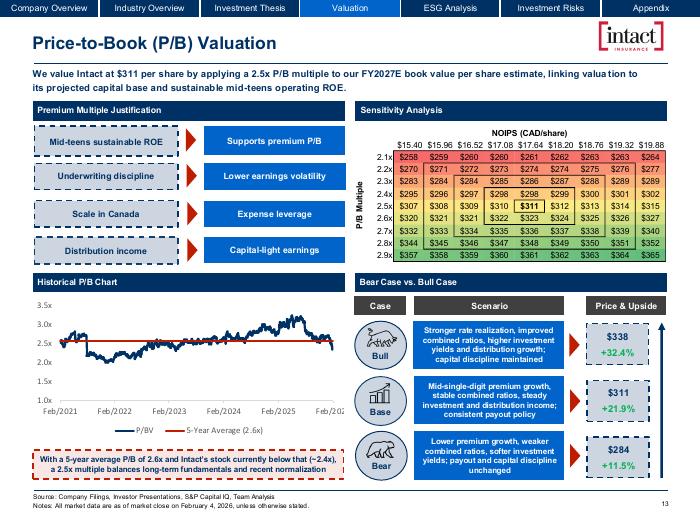
We pitched Intact to a panel of CFA charterholders on February 6, 2026. Five of us, Team C. Buy, $311 target, 21.9% upside from $255.62.
Download the deck (PDF, 24 pages)
The thesis
- Scale and underwriting discipline. Intact is Canada's biggest P&C insurer (~21% share, more than double the next one), has beaten industry ROE by about 650 bps on a ten-year average, and keeps combined ratios in the low 90s even in bad catastrophe years.
- Distribution is a second business. Broker relationships and BrokerLink made $524M of distribution income in 2024, growing ~17% a year since 2020, and it barely needs capital.
- The international book is turning. U.S. specialty lines run an 83.6% combined ratio. UK&I went from 99.3% (2022) to 92.8% (2024) and is moving from fixing to growing.
Valuation
We used price-to-book instead of DCF or P/E. Insurer earnings are noisy (cat losses, reserve moves, investment swings), but book value compounds through underwriting profit and retained capital, so that's what we anchored to. 2.5x, roughly the five-year average of 2.6x, on FY2027E book value per share of $124.37 gets you $311. P/E comps across eight Canadian, U.S. and UK insurers (pulled from S&P Capital IQ) were a sanity check and got no weight; sell-side targets got 20%.
My part: ESG
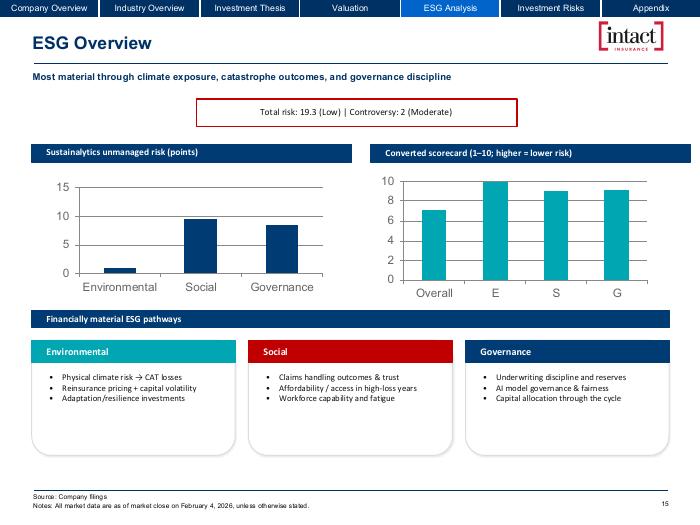
I did the ESG chapter (slides 15–18). The idea was to skip the checklist and look at what actually costs an insurer money:
- Environmental: for a P&C insurer, climate risk is the whole game. 2024 catastrophe losses were C$1.54B (a 7.1% CAT loss ratio) and the 1-in-100 probable maximum loss is about 5.7% of book value. I tied those to underwriting results and reinsurance, and argued you judge the "E" by pricing agility, not by office emissions.
- Social: claims handling, affordability in bad years, and whether the workforce can keep up (~31,000 employees, 90.4% retention, ~2 complaints per 1,000 claims). This shows up as retention and reputation when a big cat year hits.
- Governance: ESG oversight sits inside enterprise risk management at the board level, ESG metrics are in executive bonuses, and there's a formal AI-governance framework (since January 2025) for the 500+ models used in pricing and claims.
Sustainalytics has them at 19.3 (low risk) with a moderate controversy score. I turned that into a 1–10 scorecard so the panel could compare E, S and G at a glance.
Risks
UK&I integration drag from the DLG deal, a softening P&C pricing cycle with tariff-driven claims inflation, and regulatory complexity across the UK, Ireland and Luxembourg. On the other side: brand and tech unification in the UK, limited large-account exposure, and capital above board thresholds everywhere.
Team C: Audrey Kamachi, Arsalan Fakhraei, Jade Hua, William Yao, Zoey Qin. Market data as of February 4, 2026. Academic work for the CFA Institute Research Challenge, not investment advice.